Dental bridges are a popular solution for replacing missing teeth, offering a functional and aesthetically pleasing option to restore your smile. Whether you’ve lost a tooth due to decay, injury, or other dental issues, a dental bridge can help maintain the integrity of your dental structure. However, not all dental bridges are the same—there are several types to consider depending on your specific dental needs. In this guide, we’ll explore the different types of dental bridges, their benefits, and which one might be right for you.
What Is a Dental Bridge?
A dental bridge is a prosthetic device used to fill the gap left by one or more missing teeth. It consists of artificial teeth (called pontics) that are anchored to the adjacent teeth (known as abutment teeth) or dental implants. Dental bridges help restore the appearance and function of your teeth, allowing you to chew and speak normally while also preventing your remaining teeth from shifting out of position.
Types of Dental Bridges
There are four main types of dental bridges, each designed to address different dental conditions. The choice of bridge depends on factors such as the number of missing teeth, the condition of the surrounding teeth, and the location of the gap in your mouth.
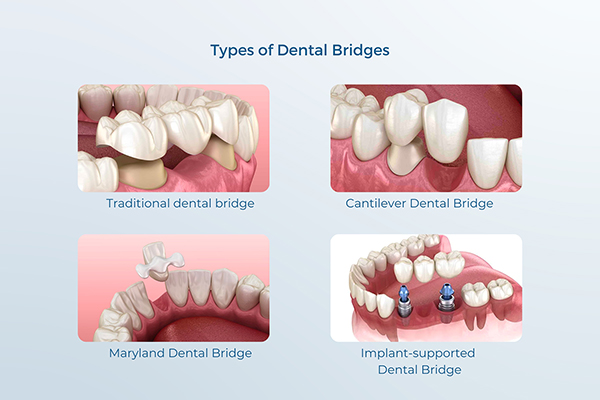
1. Traditional Dental Bridge
What It Is: A traditional dental bridge is the most common type and consists of one or more artificial teeth held in place by dental crowns that are cemented onto the adjacent teeth.
How It Works:
- The adjacent teeth (abutment teeth) on either side of the gap are prepared by removing some enamel to accommodate the crowns.
- A pontic is then placed between the crowns, and the entire structure is cemented onto the abutment teeth.
Best For:
- Patients with natural teeth on both sides of the missing tooth or teeth.
- Situations where the abutment teeth are strong and healthy enough to support the bridge.
Benefits:
- Strong and durable.
- Provides a natural look and feel.
- Ideal for replacing one or more missing teeth.
Drawbacks:
- Requires the removal of enamel from healthy adjacent teeth.
- May weaken the abutment teeth over time.
2. Cantilever Dental Bridge
What It Is: A cantilever dental bridge is similar to a traditional bridge, but it is supported by a dental crown on only one adjacent tooth, rather than two.
How It Works:
- The bridge is anchored by a single crown on one side of the gap. This means that the pontic (artificial tooth) is only supported by one abutment tooth.
Best For:
- Situations where only one adjacent tooth is available to support the bridge.
- Missing teeth in the front of the mouth, where less chewing force is applied.
Benefits:
- Preserves the enamel of the tooth on one side of the gap.
- Useful for areas where only one adjacent tooth is available.
Drawbacks:
- Less stable than a traditional bridge.
- Can place additional stress on the abutment tooth, potentially leading to complications over time.
3. Maryland Bonded Bridge (Resin-Bonded Bridge)
What It Is: A Maryland bonded bridge, also known as a resin-bonded bridge, consists of a false tooth (pontic) supported by a metal or porcelain framework. The framework is bonded to the back of the adjacent teeth rather than using dental crowns.
How It Works:
- The pontic is fused to metal or porcelain wings that are bonded to the back of the adjacent teeth with a strong adhesive.
- This method does not require the removal of enamel from the adjacent teeth.
Best For:
- Replacing missing front teeth.
- Patients with strong and healthy adjacent teeth.
- Cases where you want to avoid removing enamel from natural teeth.
Benefits:
- Minimally invasive since it does not require crowns or significant alteration of adjacent teeth.
- Preserves natural tooth structure.
- Affordable and relatively quick to apply.
Drawbacks:
- Less durable than traditional bridges.
- May not be suitable for replacing molars or teeth that experience significant biting pressure.
- The bond may weaken over time, leading to bridge failure.
4. Implant-Supported Bridge
What It Is: An implant-supported bridge is held in place by dental implants rather than by natural teeth. Each missing tooth is replaced by a dental implant, and the bridge is attached to these implants.
How It Works:
- Dental implants are surgically placed into the jawbone, serving as the roots of the missing teeth.
- Once the implants have healed and fused with the bone, a custom bridge is attached to them.
Best For:
- Patients missing several teeth in a row.
- Situations where the surrounding teeth are not healthy enough to support a traditional bridge.
- Long-term tooth replacement with increased stability.
Benefits:
- Extremely stable and durable.
- Does not rely on adjacent teeth for support, preserving natural tooth structure.
- Long-lasting and can last for decades with proper care.
Drawbacks:
- Requires surgical placement of dental implants, which is a more invasive procedure.
- Higher cost than other bridge types.
- Longer treatment time due to the need for implants to heal and integrate with the jawbone.
Which Dental Bridge Is Right for You?
The best type of dental bridge for you depends on your individual dental condition, the location of the missing teeth, and your personal preferences. Here are some factors to consider:
- Number of Missing Teeth: Traditional and implant-supported bridges are ideal for replacing multiple teeth, while cantilever and Maryland bridges are best suited for single tooth replacement.
- Location in the Mouth: Maryland and cantilever bridges are better suited for front teeth where there is less chewing pressure, while traditional and implant-supported bridges are more durable for molars.
- Condition of Adjacent Teeth: If your adjacent teeth are healthy and strong, a traditional bridge may be a good option. If they are not strong enough to support a bridge, an implant-supported bridge may be the better choice.
- Budget and Time: Implant-supported bridges are typically more expensive and time-consuming but offer long-term durability. Maryland bridges are more affordable and quicker but may not be as durable.
Conclusion
Dental bridges are an excellent option for replacing missing teeth and restoring your smile. Whether you choose a traditional bridge, cantilever bridge, Maryland bridge, or implant-supported bridge depends on your specific needs and dental health. Consulting with the best dentist in indore i.e. Dr. Vishakha jain will help you determine the best type of bridge for your situation, ensuring that you achieve a functional, natural-looking smile that lasts for years to come.